Sarkozy admits to errors in France's Tunisia policy. UK should admits their errors of judgement about Kagame's Rwanda
French President Nicolas Sarkozy said Monday that France "underestimated" the gravity of Tunisian political discontent, while noting that France's former colonial role required it to steer clear of Tunisia's "internal affairs".
Following fierce criticism of France’s position on the Tunisian crisis, French President Nicolas Sarkozy has admitted that his government “underestimated” the gravity of the situation in the North African nation.
Speaking to the press on Monday, Sarkozy noted that Tunisia’s economic and social successes masked a deep political discontent. “[B]ehind the emancipation of women, the drive for education and training, the economic dynamism, the emergence of a middle class – there was despair, a suffering, a sense of suffocation,” he said. “We have to recognise that we underestimated this.”
Sarkozy’s remarks come as France tries to adjust its diplomatic stance toward a former protectorate, with past policies having been characterised as deeply inconsistent.
Getting rid of ‘colonial habits’
France has been criticised for turning a blind eye to ousted president Zine al-Abidine Ben Ali’s repressive regime over his 23 years in power, while praising the leader’s economic initiatives and anti-terrorist rhetoric.
On January 11, as Tunisia’s anti-government street protests continued to gather force, French Foreign Minister Michèle Alliot-Marie sparked controversy by suggesting that France might consider helping Tunisian security forces better control the protesters. Her comments were slammed in France by the opposition Socialists and on the Web, where anti-Ben Ali activists had been voicing their anger and organising street demonstrations via Twitter and Facebook. In an interview with France24.com after Alliot-Marie’s statement, Vincent Geisser, a researcher specialising in the Arab world at France’s National Centre for Scientific Research, called the French response to the events in Tunisia “unrealistic and shocking to many people”.
France altered its tone when intensifying protests drove Ben Ali to flee the country on January 14, with French authorities refusing to grant their former ally refuge.
At the same time, reports surfaced that several of Ben Ali’s closest relatives, including his daughter, were already staying at a luxury hotel at the Euro Disney resort near Paris. A day later, after a Sarkozy administration spokesperson stated that Ben Ali’s relatives had no reason to remain, they left Paris for the Middle East.
French officials from both sides of the political spectrum have long offered only muted reactions to civil rights issues in Tunisia. In his press conference on Monday, Sarkozy cited France’s colonial history in the region – Tunisia acquired total independence in 1956, following a violent backlash against French rule – as the reason for treading lightly in reacting to the situation unfolding in Tunisia.
Copycat effect: How one man's self-immolation engulfed a region “The colonial power always lacks legitimacy in passing judgment on the internal affairs of an ex-colony,” Sarkozy said. “I do not want France to be likened to a country that has kept its colonial habits.”
Sarkozy also said that he had asked Prime Minister François Fillon to prepare an emergency aid package for Tunisia to help ease the country’s transition toward a new government.
France is Tunisia’s top trading partner and more than 20,000 French citizens currently reside in the country, which is known as much for its glittering Mediterranean coast as for its political woes. The Tunisian diaspora in France is estimated to be roughly 700,000 strong.
http://www.france24.com/en/20110124-sarkozy-admits-errors-tunisia-response-policy-alliot-marie-ben-ali-anti-government-protests
The dictator Kagame at UN

Dictators like Kagame who have changed their national constitutions to remain indefinitely on power should not be involved in UN high level and global activities including chairing UN meetings


Subscribe to:
Post Comments (Atom)
Thousands of Hutu murdered by Kagame inside Rwanda, e.g. Kibeho massacres
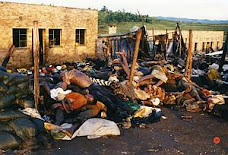
Kagame killed 200,000 Hutus from all regions of the country, the elderly and children who were left by their relatives, the disabled were burned alive. Other thousands of people were killed in several camps of displaced persons including Kibeho camp. All these war crimes remain unpunished.The British news reporters were accompanying Kagame’s fighters on day-by-day basis and witnessed these massacres, but they never reported on this.
25,000 Hutu bodies floated down River Akagera into Lake Victoria in Uganda.

The British irrational, extremist, partisan,biased, one-sided media and politicians have disregarded Kagame war crimes e.g. the Kibeho camp massacres, massacres of innocents Hutu refugees in DR. Congo. The British media have been supporting Kagame since he invaded Rwanda by organising the propaganda against the French over the Rwandan genocide, suppressing the truth about the genocide and promoting the impunity of Kagame and his cronies in the African Great Lakes Region. For the British, Rwanda does not need democracy, Rwanda is the African Israel; and Kagame and his guerilla fighters are heroes.The extremist British news reporters including Fergal Keane, Chris Simpson, Chris McGreal, Mark Doyle, etc. continue to hate the Hutus communities and to polarise the Rwandan society.
Kagame political ambitions triggered the genocide.

Kagame’s guerrilla war was aimed at accessing to power at any cost. He rejected all attempts and advice that could stop his military adventures including the cease-fire, political negotiations and cohabitation, and UN peacekeeping interventions. He ignored all warnings that could have helped him to manage the war without tragic consequences. Either you supported Kagame’ s wars and you are now his friend, or you were against his wars and you are his enemy. Therefore, Kagame as the Rwandan strong man now, you have to apologise to him for having been against his war and condemned his war crimes, or accept to be labelled as having been involved in the genocide. All key Kagame’s fighters who committed war crimes and crimes against humanity are the ones who hold key positions in Rwandan army and government for the last 15 years. They continue to be supported and advised by the British including Tony Blair, Andrew Mitchell MP, and the British army senior officials.
Aid that kills: The British Budget Support financed Museveni and Kagame’s wars in Rwanda and DRC.

Genocide propaganda and fabrications are used by the so-called British scholars, news reporters and investigative journalists to promote their CVs and to get income out of the genocide through the selling of their books, providing testimonies against the French, access to consultancy contracts from the UN and Kagame, and participation in conferences and lectures in Rwanda, UK and internationally about genocide. Genocide propaganda has become a lucrative business for Kagame and the British. Anyone who condemned or did not support Kagame’s war is now in jail in Rwanda under the gacaca courts system suuported by British tax payer's money, or his/she is on arrest warrant if he/she managed to flee the Kagame’s regime. Others have fled the country and are still fleeing now. Many others Rwandans are being persecuted in their own country. Kagame is waiting indefinitely for the apologies from other players who warn him or who wanted to help to ensure that political negotiations take place between Kagame and the former government he was fighting against. Britain continues to supply foreign aid to Kagame and his cronies with media reports highlighting economic successes of Rwanda. Such reports are flawed and are aimed at misleading the British public to justify the use of British taxpayers’ money. Kagame and his cronies continue to milk British taxpayers’ money under the British budget support. This started from 1986 through the British budget support to Uganda until now.
Dictator Kagame: No remorse for his unwise actions and ambitions that led to the Rwandan genocide.

No apologies yet to the Rwandan people. The assassination of President Juvenal Habyarimana by Kagame was the only gateway for Kagame to access power in Rwanda. The British media, politicians, and the so-called British scholars took the role of obstructing the search for the truth and justice; and of denying this assassination on behalf of General Kagame. General Paul Kagame has been obliging the whole world to apologise for his mistakes and war crimes. The UK’s way to apologise has been pumping massive aid into Rwanda's crony government and parliement; and supporting Kagame though media campaigns.
Fanatical, partisan, suspicious, childish and fawning relations between UK and Kagame

Kagame receives the British massive aid through the budget support, British excessive consultancy, sector wide programmes, the Tutsi-dominated parliament, British and Tutsi-owned NGOs; for political, economic and English language expansion to Rwanda. The British aid to Rwanda is not for all Rwandans. It is for Kagame himself and his Tutsi cronies.

Paul Kagame' actvities as former rebel
No comments:
Post a Comment
Note: only a member of this blog may post a comment.