The U.N. High Commissioner for Human Rights on Friday issued a somewhat watered-down report detailing allegations that Rwanda and its allies may have committed genocide against ethnic Hutu refugees in eastern Congo between 1993 and 2003. The release of the long-awaited 566-page report -- referred to as a mapping exercise -- comes several weeks after a draft version of the damning report leaked to the French newspaper Le Monde, prompting Rwanda to threaten to withdraw thousands of its peacekeepers from Darfur and other U.N. missions in retaliation. Despite the changes, the final report still constitutes the most comprehensive and damning official account of crimes committed in one of Africa's deadliest conflict zones. And it continues to assert that an alliance of Rwandan, Burundian soldiers and Congolese rebels may have committed genocide during military operations in eastern Congo during the 1990s. But it has softened its finding with numerous words and phrases -- including "alleged", "suggests" "apparent" and "if proven in a court of law" -- that serve to lessen the force of some of the final conclusions. Instead of stating whether crimes had been committed, the final report leaves it to a court to definitively decide. The final text also contains a far more detailed and robust set of countervailing legal arguments suggesting that Rwandanan forces, in fact, may not have committed genocide despite possible culpability for large-scale killings of civilians, and that any final decision would have to be made by a court. The decision to amend the final text came after U.N. Secretary General Ban Ki-moon's top advisors, including his chief of staff, Vijay Nambiar, voiced concern to the High Commissioner, Navi Pillay, about the legal basis for the genocide charge. A top U.N. official, who was involved in the deliberations, insisted that the effort to revise the text was not carried out to assuage the Rwandans. The violence in eastern Congo stems from the 1994 Rwandan genocide, where ethnic Hutu extremists, backed by the former government, orchestrated the murder of more than 800,000 ethnic Tutsi and moderate Hutu. Rwanda's current president, Paul Kagame, was the commander of the Uganda-based Tutsi rebel army, the Rwandan Patriotic Army(RPA), that now stands accused of wrongdoing. It was the RPA under Kagame's command that seized power in Kigali and drove the Hutu perpetrators of the Rwandan genocide, together with hundreds of thousands of Hutu civilians, across the border into eastern Congo (then known as eastern Zaire). The report maintains that they conducted massive atrocities along the way. In 1996, the Rwandan army fashioned an alliance -- known as the The Alliance des Forces Democratiques pour la Liberation du Congo-Zaire (AFLD) -- with Burundian forces, and a Congolese rebel leader, Laurent Desire Kabila. The force initially launched a series of attacks on the Rwandan refugee camps in Congo, which had been used as a staging ground for attacks against the new Rwandan government. The mapping exercise was set up, in part, to investigate crimes committed by Rwanda and its allies as they continued their military campaign to Kinshasha, where they overthrew the government of Mobutu Sese Seko and installed Kabila as the leader of the newly named Democratic Republic of Congo. But the report also documents crimes by numerous other countries, including Uganda, and various rebel groups who were drawn into Congo's widening war. The report was tasked with investigating 617 mass killings in eastern Congo between 1993 and 2003. The final version noted that the majority of victims were children, women, the elderly and the sick, and that they were often murdered with the claw edge of a hammer. "The apparent systematic and widespread attacks described in this report reveal a number of inculpatory elements that, if proven before a competent court, could be characterized as crimes of genocide," according to the report. The report added, however, took pains to say that there are "a number of countervailing factors that could lead a court to find that the requisite intent was lacking, and hence that the crime of genocide was not committed." "Facts which tend to show that the RPA/AFDL spared the lives, and in fact facilitated the return to Rwanda of very large numbers of Hutu militate against proving a clear intent to destroy the group," the report said. The report also argues that it is "very difficult to establish" a genocidal intent where an "alternative inference" can be drawn from the conduct of a perpetrator. The report then sets out to propose a series of alternative theories for attacking Hutu refugee camps, including the possibility that Rwanda and its Congolese allies were engaging in "collective retribution" against Hutu civilians suspected of having engaged in the Rwanda genocide -- a horrific crime perhaps, but not genocide. The reports release comes weeks after Ban Ki-moon, his peacekeeping chief, and his human rights advisors, traveled to Kigali to meet with President Kagame. After the meeting, Kagame backed down from a threat to withdraw his peacekeepers. But he has made it clear that he will carry through with it if the U.N. presses ahead with the prosecution of Rwandan officers implicated in the crimes. Rwanda's foreign minister Louise Mushikiwabo reacted angrily to the report, saying that "Rwanda categorically states that the document is flawed and dangerous from start to finish." She said that the report's findings constitute "a moral and intellectual failure, as well as an insult to history." Human rights activists said they were confident that despite amendments that softened the report it still presented an overwhelming body of evidence that will now be hard to ignore. The challenge now, they say, is to press ahead with some mechanism for holding perpetrators accountable. "The real question is, does the political will exist to have a process that identifies individual perpetrators, or those most responsible, and brings them to justice? The report does a good job of fleshing out the facts as they are known." Here's a sample of the changes the U.N. introduced into the final report: BEFORE: With the respect to the charge of genocide, the original draft report noted that there were developments -- like Rwanda's repatriation of hundreds of thousands of Hutu refugee -- that would cause jurists to hesitate in reaching a genocide ruling. AFTER: The final version included a far more detailed account of the challenges in securing a genocide finding: "In the absence of direct evidence of intent to destroy the group, such intent can only be inferred from circumstantial facts and evidence, that is, from the conduct of the alleged perpetrator, if it is the only reasonable inference possible. Where an alternative inference can be drawn from the conduct of the alleged perpetrator, the clear 'intent to destroy' required is difficult to establish. A number of alternative explanation or inferences could be drawn from the conduct of the RPA/AFDL in attacking the camps in Zaire in 1996 and 1997. The intent underlying the killings could be deemed as collective retribution against Hutu civilians in Zaire suspected of involvement with the ex-FAR/Interhamwe, reinforced by the RPA/AFDL's conviction that upon destroying the camps, all Hutu remaining in Zaire were in sympathy with the perpetrators of the 1994 genocide in Rwanda." -- BEFORE: "In conclusion, the vast majority of violent incidents listed in this report are the result of armed conflict and point to the commission of war crimes and serious breaches of international humanitarian law." AFTER: "In conclusion, the vast majority of violent incidents listed in this report are the result of armed conflict and IF PROVEN IN A JUDICIAL PROCESS, point to the commission of war crimes AS serious breaches of international humanitarian laws." -- BEFORE: "This report shows that the vast majority of incidents listed fall within the scope of widespread or systematic attacks, depicting multiple acts of large scale violence, carried out in an organized fashion and resulting in numerous victims." AFTER: "This report shows that the vast majority of incidents listed, IF INVESTIGATED AND PROVEN IN A JUDICIAL PROCESS, fall within the scope of widespread or systematic attacks, depicting multiple acts of large-scale violence, APPARENTLY carried out in an organized fashion and resulting in numerous victims." -- BEFORE: "It could be noted, however, that certain elements could cause a court to hesitate to decide on the existence of a genocidal plan, such as the fact that as of 15 November, 1996, several tens of thousands of Rwandan Hutu refugees, many of whom had survived previous attacks, were repatriated to Rwanda with the help of the AFDL.APR authorities." AFTER: "There are however a number of countervailing factors that could lead a court to find that the requisite intend was lacking, and hence that the crime of genocide was not committed...Finally, facts which tend to show that the RPA/AFDL spared the lives, and in fact facilitated the return to Rwanda of very large numbers of Hutu militate against proving a clear intent to destroy the groups." -- BEFORE: "Whilst in general the killings did not spare women and children, it should be noted that in some places, particularly at the beginning of the first war in 1996, Hutu women and children were in fact separated from the men, and only the men were subsequently killed." AFTER: "Whilst in general the killings did not spare women and children, it should be noted that in some places, particularly at the beginning of the first war in 1996, Hutu women and children were APPARENTLY separated from the men, and ALLEGEDLY only the men were subsequently killed." -- BEFORE: "It is therefore possible to assert that, even if only a part of the Hutu population in Zaire was targeted and destroyed, it could nonetheless constitute a crime of genocide if this was the intention of the perpetrators." AFTER: "ACCORDING TO RELEVANT JURISPRUDENCE, even if only part of the Hutu population in Zaire was targeted and destroyed, it could nonetheless constitute a crime of genocide if this was the intention of the perpetrators." Follow me on Twitter @columlynch |
The dictator Kagame at UN

Dictators like Kagame who have changed their national constitutions to remain indefinitely on power should not be involved in UN high level and global activities including chairing UN meetings
2 Oct 2010
U.N. waters down genocide charges against Rwandan forces in Congo


Subscribe to:
Post Comments (Atom)
Thousands of Hutu murdered by Kagame inside Rwanda, e.g. Kibeho massacres
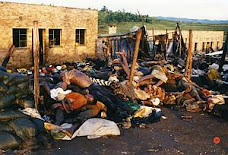
Kagame killed 200,000 Hutus from all regions of the country, the elderly and children who were left by their relatives, the disabled were burned alive. Other thousands of people were killed in several camps of displaced persons including Kibeho camp. All these war crimes remain unpunished.The British news reporters were accompanying Kagame’s fighters on day-by-day basis and witnessed these massacres, but they never reported on this.
25,000 Hutu bodies floated down River Akagera into Lake Victoria in Uganda.

The British irrational, extremist, partisan,biased, one-sided media and politicians have disregarded Kagame war crimes e.g. the Kibeho camp massacres, massacres of innocents Hutu refugees in DR. Congo. The British media have been supporting Kagame since he invaded Rwanda by organising the propaganda against the French over the Rwandan genocide, suppressing the truth about the genocide and promoting the impunity of Kagame and his cronies in the African Great Lakes Region. For the British, Rwanda does not need democracy, Rwanda is the African Israel; and Kagame and his guerilla fighters are heroes.The extremist British news reporters including Fergal Keane, Chris Simpson, Chris McGreal, Mark Doyle, etc. continue to hate the Hutus communities and to polarise the Rwandan society.
Kagame political ambitions triggered the genocide.

Kagame’s guerrilla war was aimed at accessing to power at any cost. He rejected all attempts and advice that could stop his military adventures including the cease-fire, political negotiations and cohabitation, and UN peacekeeping interventions. He ignored all warnings that could have helped him to manage the war without tragic consequences. Either you supported Kagame’ s wars and you are now his friend, or you were against his wars and you are his enemy. Therefore, Kagame as the Rwandan strong man now, you have to apologise to him for having been against his war and condemned his war crimes, or accept to be labelled as having been involved in the genocide. All key Kagame’s fighters who committed war crimes and crimes against humanity are the ones who hold key positions in Rwandan army and government for the last 15 years. They continue to be supported and advised by the British including Tony Blair, Andrew Mitchell MP, and the British army senior officials.
Aid that kills: The British Budget Support financed Museveni and Kagame’s wars in Rwanda and DRC.

Genocide propaganda and fabrications are used by the so-called British scholars, news reporters and investigative journalists to promote their CVs and to get income out of the genocide through the selling of their books, providing testimonies against the French, access to consultancy contracts from the UN and Kagame, and participation in conferences and lectures in Rwanda, UK and internationally about genocide. Genocide propaganda has become a lucrative business for Kagame and the British. Anyone who condemned or did not support Kagame’s war is now in jail in Rwanda under the gacaca courts system suuported by British tax payer's money, or his/she is on arrest warrant if he/she managed to flee the Kagame’s regime. Others have fled the country and are still fleeing now. Many others Rwandans are being persecuted in their own country. Kagame is waiting indefinitely for the apologies from other players who warn him or who wanted to help to ensure that political negotiations take place between Kagame and the former government he was fighting against. Britain continues to supply foreign aid to Kagame and his cronies with media reports highlighting economic successes of Rwanda. Such reports are flawed and are aimed at misleading the British public to justify the use of British taxpayers’ money. Kagame and his cronies continue to milk British taxpayers’ money under the British budget support. This started from 1986 through the British budget support to Uganda until now.
Dictator Kagame: No remorse for his unwise actions and ambitions that led to the Rwandan genocide.

No apologies yet to the Rwandan people. The assassination of President Juvenal Habyarimana by Kagame was the only gateway for Kagame to access power in Rwanda. The British media, politicians, and the so-called British scholars took the role of obstructing the search for the truth and justice; and of denying this assassination on behalf of General Kagame. General Paul Kagame has been obliging the whole world to apologise for his mistakes and war crimes. The UK’s way to apologise has been pumping massive aid into Rwanda's crony government and parliement; and supporting Kagame though media campaigns.
Fanatical, partisan, suspicious, childish and fawning relations between UK and Kagame

Kagame receives the British massive aid through the budget support, British excessive consultancy, sector wide programmes, the Tutsi-dominated parliament, British and Tutsi-owned NGOs; for political, economic and English language expansion to Rwanda. The British aid to Rwanda is not for all Rwandans. It is for Kagame himself and his Tutsi cronies.

Paul Kagame' actvities as former rebel
No comments:
Post a Comment
Note: only a member of this blog may post a comment.